The Old Whitney Building Has Had Four Names. The Dining Room Underneath It Never Closed.
Walk east on 75th Street toward Madison on a weekday morning and you will probably see a line. Not for a museum ticket. For a pastry box in dusty blue and pale peach, the kind you carry out of a place called La Mercerie Patisserie, tucked into the lower level of the building most Upper East Siders still call the old Whitney.
That building has not been the Whitney in over a decade. It has not been much of anything for very long, actually. It has been the Whitney Museum of American Art, then the Met Breuer, then a temporary Frick, and now, as of last November, the global headquarters of Sotheby's. Four identities in one lifetime for a single address at Madison and 75th. What almost nobody mentions is that through every one of those handoffs, the room downstairs never stopped serving food.
The building itself is not new. Marcel Breuer designed it for the Whitney in 1966, an inverted concrete form that critics at the time found strange enough to compare to a Babylonian ziggurat. It held the Whitney's collection until the museum decamped downtown to a Renzo Piano building in the Meatpacking District. From there, the same walls at 945 Madison passed through a short but well documented list of tenants:
Each occupant rented the galleries but never owned the address until Sotheby's did. That is a meaningful shift for a building that had spent nearly six decades being borrowed.
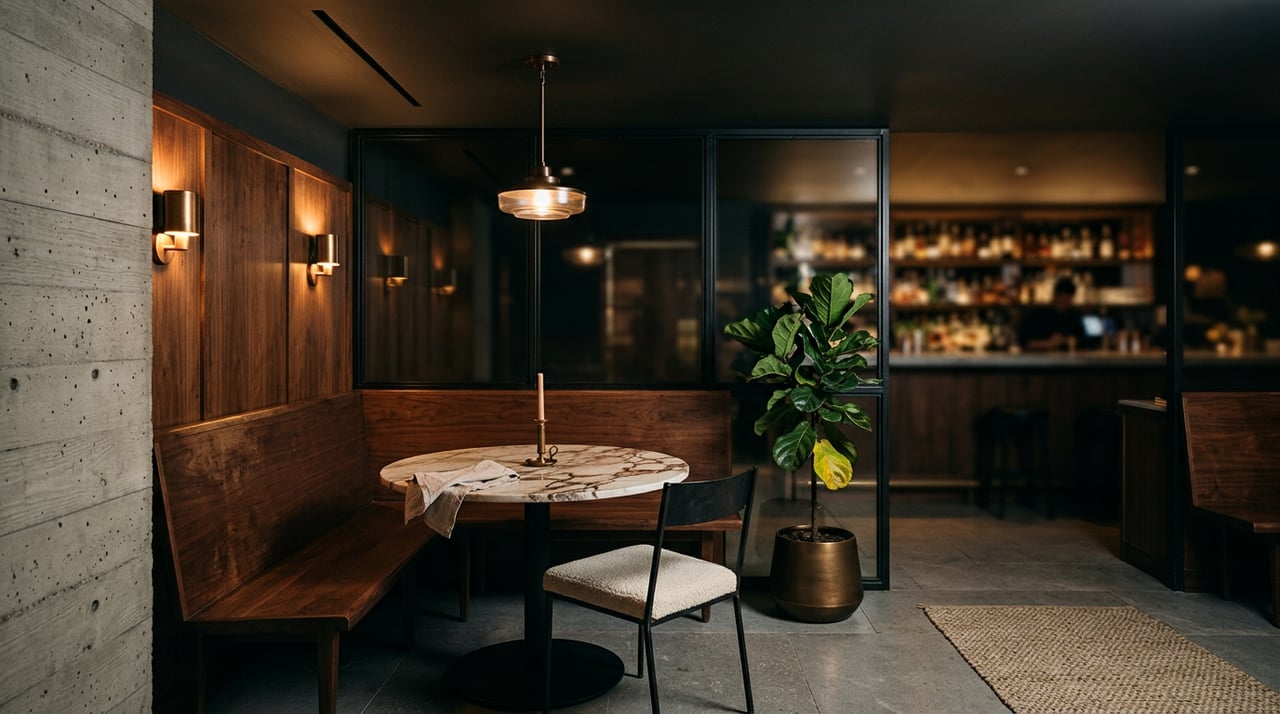
Here is the part that gets lost in every headline about the new restaurant. The lower level of 945 Madison has run a food operation since the year the building opened. A cafeteria-style restaurant served visitors in 1966. Sarabeth's took over the space starting in 1991. When the Met occupied the building as the Met Breuer, the room became Flora Bar. Now, under Sotheby's, it is Marcel.
Four owners, four names for the building, and one continuous kitchen in the same footprint for sixty years. What changed each time was not whether there would be a restaurant. It was what the restaurant was for.
Robin Alesch, who designed Marcel with her husband Stephen through their studio Roman and Williams, put the old arrangement plainly: institutional restaurants tend to be "a very intentional sidebar to what is the main focus," which at a museum is always the art, never the meal. That was true in 1966 and it was still true when Flora Bar closed with the Met's departure in 2020. The dining room existed to keep visitors fed between galleries, nothing more.
Sotheby's inherited more than a kitchen when it took the building. In May 2025, the New York City Landmarks Preservation Commission designated 945 Madison as both an individual and an interior landmark, extending legal protection to the exterior and to specific interior spaces including the lobby and main staircase. That designation meant Roman and Williams could not simply gut the lower level and start over.
Their solution was to split the room. The central dining area, which falls under landmark protection, keeps Breuer's original bush-hammered concrete columns and lighting untouched. The bar and kitchen, which sit outside the protected footprint, got walnut paneling, vintage Bauhaus stools, and Breuer table lamps the designers sourced separately. It is one restaurant built across two sets of rules, and you can feel the seam if you know to look for it.
The most specific detail from the renovation involves a piece of hardware that never made it to market. Breuer designed custom door fittings for a model house he built in MoMA's sculpture garden back in 1949, but the design was never produced. The specialty hardware house E.R. Butler still had the original drawings in its archive and manufactured the pieces for Marcel, six decades after Breuer first sketched them.
"We love this beast," Stephen Alesch has said of working inside Breuer's concrete. "We want to dance with it."
The sidebar status Robin Alesch described has a lot to do with what kind of institution is upstairs. A museum's business is the art itself, and the restaurant exists to support that mission. Sotheby's business is selling the art. That single fact changes what it means to eat in this room.
Diners at Marcel sit beneath a rotating selection of pieces pulled from Sotheby's own inventory, works by artists like Joan Mitchell, Andy Warhol, and Alexander Calder that hang there the same way they would in the galleries upstairs, except these are for sale. The wine list draws on Sotheby's own cellar, including vintages normally held back for auction. For the first time in the building's history, the meal and the merchandise share the same room. The art on the wall is not decoration borrowed from a museum's permanent collection. It is inventory that might be gone by next quarter.
None of this means the building suddenly requires a paddle number to enter. Sotheby's charges no admission fee, a departure from how the space operated as a museum, and the ground floor is open to anyone curious enough to walk in.
Marcel itself has already picked up a reputation as one of the harder reservations in the city this year, the kind of booking that gets more competitive once the opening photos circulate. But La Mercerie Patisserie, the all-day bakery tucked inside Marcel and run by pastry chefs Alexandra Puglisi and Rae Gaylord, operates as a walk-in counter. Croissants, madeleines in yuzu and raspberry glaze, and seasonal tarts are available to eat in or take away with no reservation required. The building's original sculpture garden has also been reopened as an alfresco dining space, seating breakfast, lunch, and dinner among the trees and sculptures that used to sit there quietly during the museum years.
The building has also picked up a public event calendar to match its new commercial identity. The Independent 20th Century art fair, which had outgrown its previous venue, moved its 2026 edition into the Breuer building with 75 percent more exhibitor space than before, another sign that this address is drawing foot traffic well beyond people with business at the auction house.
Sixty years is a long time for a corner of Madison Avenue to keep reinventing its name while quietly refusing to let the kitchen go dark. The Whitney needed a restaurant to keep patrons fed between galleries. Sotheby's built one that puts the transaction itself on the table. Next time you walk past 945 Madison, look past the awning. The name changed again. The pastry counter did not.
If buildings that keep finding new lives on the Upper East Side interest you as much as they interest us, that is exactly the kind of neighborhood detail Danielle Lacko Real Estate pays attention to. Whether you are watching this corner for the architecture or wondering what your own corner of the neighborhood is worth, Request a Home Valuation any time you are ready to talk.
Stay up to date on the latest real estate trends.
Get assistance in determining current property value, crafting a competitive offer, writing and negotiating a contract, and much more. Contact me today.