Bay Head's Beach Runs On Private Checks, Not Public Budgets
Walk down to Mount Street this week, in the last stretch before badges come down for the season on September 7, and you will pass two low piles of gray boulders that were not there a year ago. They sit close to the sand, easy to miss unless you know what you are looking at, forming the shape of a groin that reaches toward the water. A matching one sits a few blocks south at Karge Street. Somebody had to want these enough to pay for them without asking the town for a dime.
That somebody was a small group of residents working through the Bay Head Improvement Association and the Bay Head Preservation Alliance. The bill came to roughly a million dollars, and none of it touched a municipal budget line, a state grant, or a bond vote. It was a private check, cut by people who live here and got tired of watching sand disappear.
The old wooden groins at Mount and Karge dated back to the 1960s and had spent decades buried and falling apart, doing almost nothing to hold the beach in place. Every few years the state would truck in fresh sand through a taxpayer-funded replenishment, and every few years a storm would carry most of it away. Bay Head Improvement Association president Bill Gage put it plainly when construction started this spring: the group had spent five or six years working through state permits before a single boulder could move.
Once the paperwork cleared, the work itself went fast. Boulders shipped in from western New Jersey, crews cut a trench in the tidal zone, and the rocks were craned into place over about a month. Gage said the one condition the organizers set for their private funders was that the job had to be finished well before beach season began, not after. Mayor Bill Curtis framed it in terms of what the town actually depends on: the beach, the tourism it draws, and the rental income that keeps a lot of Bay Head households afloat.
Groins work differently than the sand-pumping most shore towns rely on. Rather than dumping new sand on top of a beach and hoping it stays, they trap sand that is already moving south to north in the natural current, building a shelf that holds instead of a surface that gets scraped clean by the next nor'easter. It is a slower kind of fix, and a more permanent one, and in this case a private one.
This is not the first time Bay Head's beach protection has come from private pockets instead of public ones. Back in 1882, before the borough was even incorporated, the town's original developers built a stone rubble seawall running roughly 4,130 feet along the coast. Over the following decades it disappeared under the natural dunes and mostly slipped out of memory, a buried piece of engineering nobody thought about until Hurricane Sandy tore into the coastline in 2012 and exposed it again.
The town itself did not exist yet when that wall went in. Three Princeton bankers had formed the Bayhead Land Company in 1879 with about $12,000 in capital, laid out a simple street grid, and started selling lots. Protecting the beach was their problem to solve if they wanted the lots to sell, so they solved it themselves. Bay Head would not become an official borough until 1886. The pattern of private money building the town's flood defenses predates the town's own government by four years.
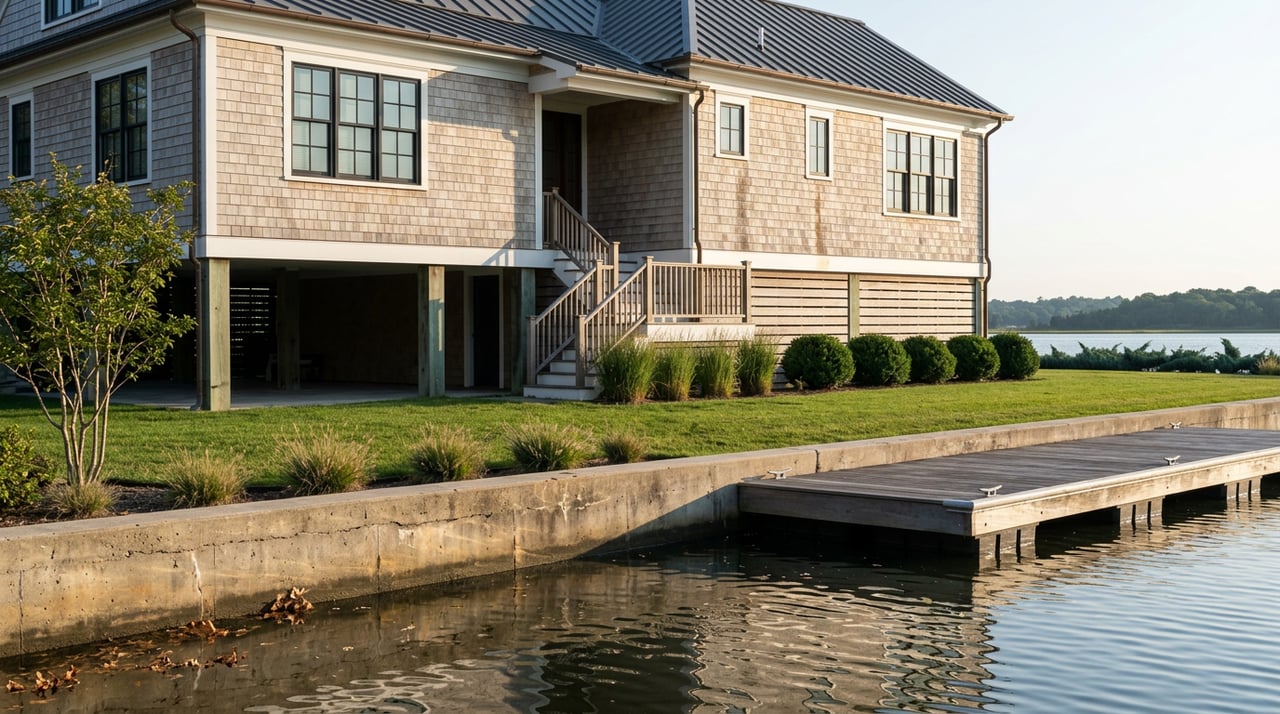
The same instinct shows up in the building that anchors the harbor side of town. The Bay Head Yacht Club was founded on September 8, 1888, and its clubhouse went up the following year on pilings at the head of Barnegat Bay, reachable only by boardwalk. A larger clubhouse replaced it in 1928 to keep up with a growing membership, and that is the building still standing today.
Sandy hit it hard. The wood pilings had reached the point of failure, and the club faced a choice between letting the building go or funding a full rebuild themselves. They chose the second option. Engineers drove roughly 100 concrete-filled steel piles as deep as 80 feet into Barnegat Bay, then raised the entire clubhouse 11 to 14 feet and lowered it back onto the new foundation, a story taller than before. The project ran through club dues, not municipal recovery funds, and it wrapped up in the spring of 2015. Members wanted their building back the way it was, so they paid for it the way they always have, among themselves.
Commercial turnover here follows a smaller version of the same logic. At 58 Bridge Avenue, the space that used to hold Dune Grass Cafe now belongs to Taylor Sam's, a family-run breakfast and lunch spot that started in Brick and expanded to the shore this year. It is open daily through the morning and early afternoon, adds dinner service on Friday and Saturday nights through the season, and keeps its ice cream window running until 9 p.m. all summer. The menu leans into scratch cooking with a Jersey accent, taylor ham on nearly everything, homemade blueberry syrup, a soup of the moment that changes by the week.
A few doors down at 80 Bridge Avenue, Mueller's Bakery has been the one fixture nobody touches, a family-owned institution that has outlasted several rounds of storefront turnover around it. Around the corner on Lake Avenue, Noon Design Shop sells handmade gifts and pillows out of a small storefront and runs its own coffee counter, Coffee at Noon, inside. None of these are chains. None of them needed a zoning fight or a redevelopment plan to open. They are small operators making their own bet on Bridge Avenue foot traffic, the same way the beach groups made their own bet on rock and the yacht club made its own bet on steel pilings.
Money keeps moving through the same channel on the ecology side too. Save Barnegat Bay, the nonprofit that has worked to protect the bay watershed since 1971, held its 2026 Sips and Shells fundraiser on July 11, this year themed around the plant life that holds Barnegat Bay's shoreline together and filters its water. The location was the Bay Head Yacht Club, the same raised clubhouse that survived Sandy on private dues, now hosting a private fundraiser for bay health.
Save Barnegat Bay does not run on state appropriations. It funds its rain barrel program, its work on sea nettle populations, and its advocacy on stormwater policy through memberships and events like this one. When the group listed Bay Head's own coastal work at a recent regional resilience conference, the contact line pointed to a borough staffer working on stormwater around Twilight Lake, not a state agency. The pattern holds at the watershed level the same way it holds at the block level. Somebody local organizes it, somebody local pays for it.
Even the sand under your beach chair is not the town's to manage. The beaches in Bay Head are owned and operated by the Bay Head Improvement Association, a private nonprofit, not by the borough government. A full season badge runs $120, half season is $65, and a single day costs $15, and every dollar goes through that same private channel rather than a municipal recreation fund.
None of this means Bay Head is ungoverned. The mayor and council still run council meetings, the public works department still handles recycling stickers, and the borough still shows up in the state's coastal monitoring data. But when something actually needs fixing on the waterfront, whether that is a groin, a clubhouse foundation, or a stretch of eroding dune, the money and the decision-making tend to start with the people who live here rather than with a government line item. It has worked that way since three bankers laid out the first streets in 1879, and it is still working that way as this year's beach season closes out.
If you are watching this town from the outside and wondering what it actually takes to hold a piece of it, the honest answer is that Bay Head's residents have never waited around to find out. They organize, they write the check, and they fix it themselves.
If you would like a clearer picture of what a home in Bay Head is actually worth this season, given a market where residents are this invested in protecting their own shoreline, Danielle Lacko can walk you through it. Request a home valuation and get a read on the market that accounts for what makes this stretch of the Jersey Shore different from the next one down the coast.
Stay up to date on the latest real estate trends.



Get assistance in determining current property value, crafting a competitive offer, writing and negotiating a contract, and much more. Contact me today.